01
Side by side
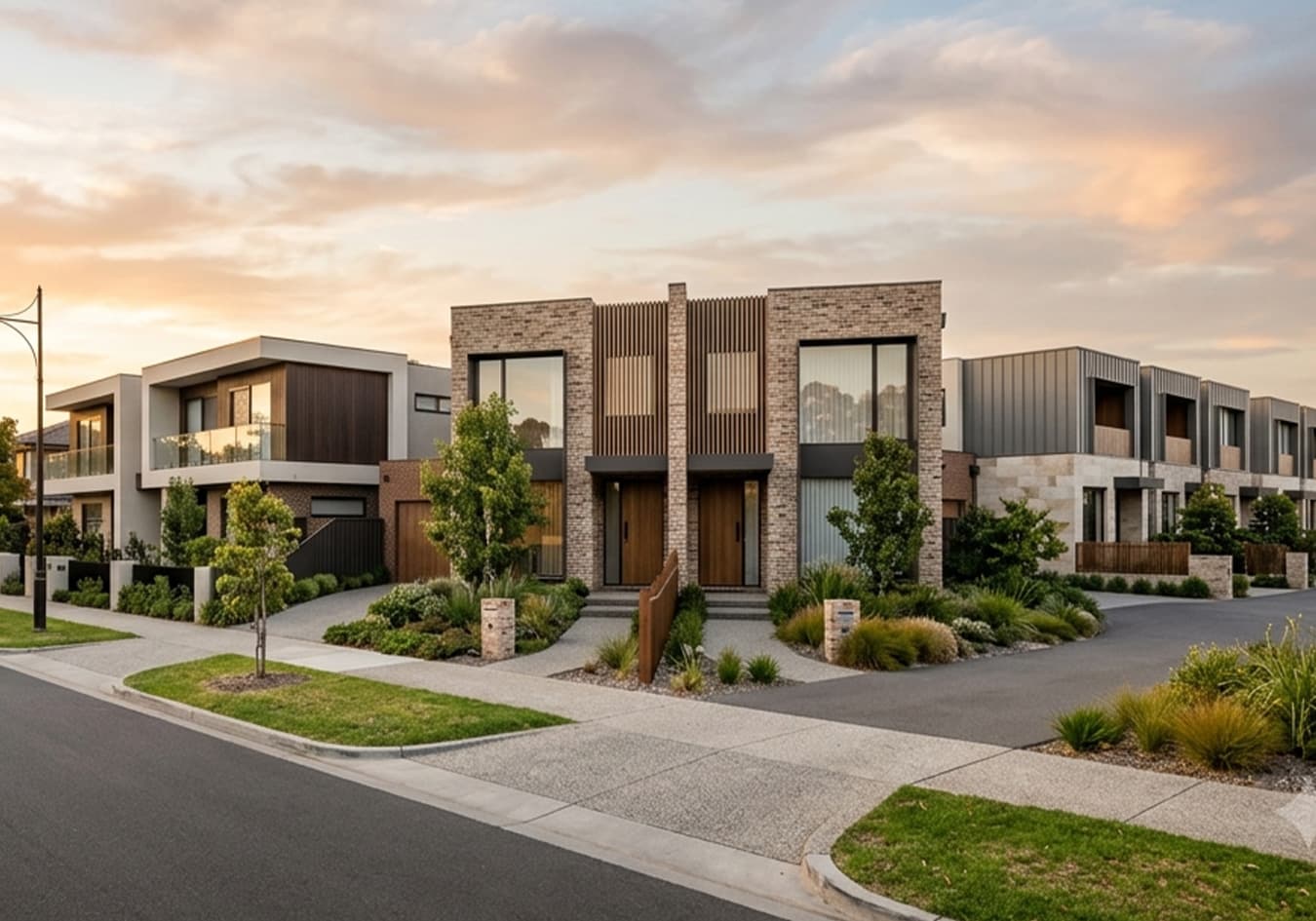
two separate dwellings positioned across the width of the block, each with its own entry
A dual occupancy is two dwellings built on one block of land under a single title, and it is one of the most direct ways to increase the return on land you already own. Building a dual occupancy in Melbourne generally costs between $400,000 and $600,000 per dwelling depending on the area and council, plus $80,000 to $120,000 in development costs on top of the build.
Your block needs sufficient size, frontage and the right zoning to support two dwellings, and a feasibility assessment confirms this before you commit. Lucky Homes designs and builds dual occupancy, duplex and townhouse developments across Melbourne as a registered Victorian building practitioner, with fixed-price contracts and build times that keep holding costs down.
01
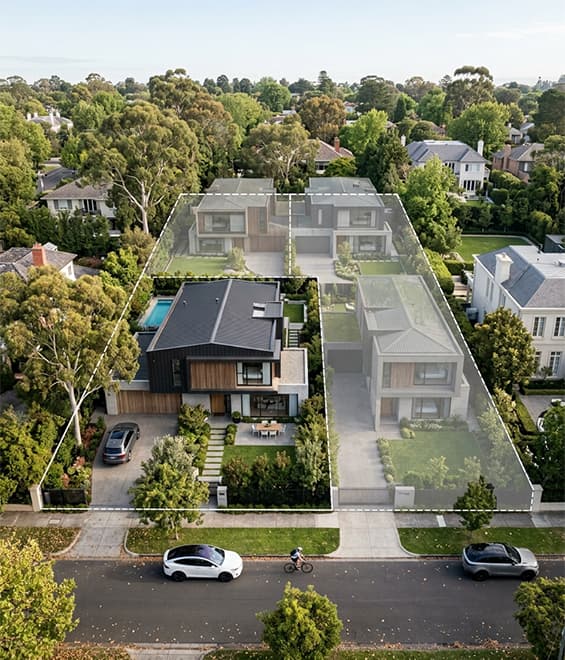
A dual occupancy is two dwellings built on one block of land under a single title. Both homes sit on the same parcel of land, and the land remains one legal title until it is formally subdivided. This is the structure most landowners and investors use to place a second home on a block that already has capacity for it.
Dual occupancy takes three common forms:
01
two separate dwellings positioned across the width of the block, each with its own entry
02
two dwellings under one roof sharing a party wall between them
03
one dwelling behind the other, usually with a shared driveway down one side
02
Your block needs sufficient size, frontage and the right zoning to support two dwellings. Not every block does, and finding out after you have committed to a design is an expensive way to learn it. A feasibility assessment answers the question before any money is spent on drawings or contracts.
The factors that determine whether a block works:
03
Building a dual occupancy in Melbourne generally costs between $400,000 and $600,000 per dwelling, depending on size, finishes and site conditions. Construction rates sit at roughly $18,000 to $22,000 per square. The figures on this page are general Melbourne market averages, not a Lucky Homes quote, and the final cost varies with your block, design and selections.
| Build level | Typical cost per dwelling |
|---|---|
| Basic / standard | $380,000 – $500,000 |
| Mid-range custom | $500,000 – $650,000 |
| High-end | $650,000 – $800,000+ |
The build cost is only part of the total. Development costs sit on top of the construction contract, and they are where dual occupancy budgets most often come undone:
| Development cost | Typical range |
|---|---|
| Permits and council fees | $15,000 – $45,000 |
| Site costs and earthworks | $20,000 – $40,000 |
| Professional services | $35,000 – $50,000 |
| Landscaping, fencing and driveways | $25,000 – $45,000 |
Development costs add roughly $80,000 to $120,000 on top of the build, so a realistic total project budget has to account for both figures rather than the construction contract alone. A complete dual occupancy project in Melbourne commonly lands between $1.0 million and $1.8 million for both dwellings once development costs are included.
Where you build changes the numbers. The larger, flatter estate blocks across Melbourne growth corridor generally carry lower site costs and earthworks than constrained inner-suburban blocks with slope, access limits or difficult soil. That difference alone can move a project's feasibility.
04
Lucky Homes takes a dual occupancy from block feasibility through council approval to the handover of both dwellings.
01
The block is assessed for size, frontage, zoning, easements and orientation, and you receive an honest answer on what your land supports before any commitment.
02
Both homes are designed together, with attention to privacy, light and street presentation for each, rather than one home divided into two.
03
Lucky Homes prepares the town planning application and manages it through council. Council approval is the longest and least predictable stage of a dual occupancy, and planning for it protects your budget. Design through to council submission commonly takes around three months, and approval itself can take six to twelve months depending on the council and the complexity of the site.
04
Once planning is approved, building permits and construction documentation are prepared and lodged.
05
Both homes are built under the supervision of your registered builder, with the trades, staging and shared services coordinated across the two dwellings.
06
Both dwellings are completed, inspected and handed over with a 10-year structural warranty.
05
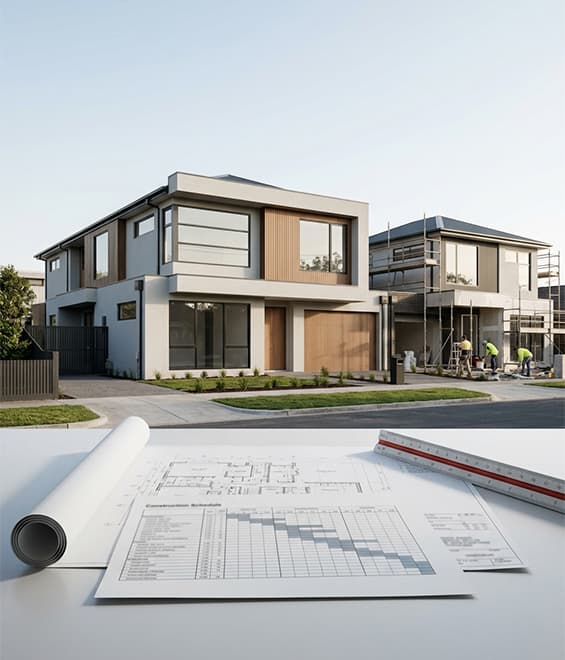
Every month a dual occupancy sits unfinished, holding costs continue to accumulate against your return. Loan interest runs through the approval period and the entire construction program, and those costs come directly out of the project's margin. Build speed is a financial factor on a dual occupancy, not a convenience.
Lucky Homes completes single storey homes in around four to five months and double storey homes in around seven to nine months, which shortens the window during which holding costs accrue. Timing depends on design complexity, site conditions and weather, and you receive a realistic construction program before work begins.
Price certainty protects the return the same way. Variations raised mid-build can erode the margin an investor calculated at the outset, which is why Lucky Homes sets the scope and the price in a fixed-price contract before construction starts, with upgrades and changes agreed in writing.
06
A dual occupancy has to work as two separate homes, not one home divided in half. Both dwellings need to be comfortable to live in and attractive to a tenant or a buyer, because the weaker of the two sets the ceiling on what the project returns.
The design decisions that determine how both dwellings perform:
01
both homes need access to northern light, not one at the expense of the other
02
window placement and outdoor areas positioned so neither dwelling overlooks the other
03
proper treatment of the shared party wall between the two homes
04
independent access, metering and utilities for each dwelling
05
a facade designed for the streetscape rather than duplicated across both homes
06
both dwellings built to the Victorian energy standard, with solar and all-electric options
07

Lucky Homes is a registered Victorian building practitioner that has delivered more than 300 homes across Melbourne since 2011. The business holds registration CBU54601, carries domestic building insurance on every project, and backs each completed home with a 10-year structural warranty.
You deal directly with Mohsin Shafiq, the registered builder who runs your project, rather than a sales consultant you never see again after signing. On a two-dwelling project with double the trades and double the scheduling, direct access to the person accountable for the build is the difference between problems being caught early and problems compounding quietly.
Lucky Homes has built for investors managing their project from outside Victoria, including clients in Canberra and Sydney who relied on the builder to run the design, approvals and construction on their behalf. Fixed-price contracts, defined scope and fast build times are what make a remote or investment build workable.
08
Lucky Homes builds dual occupancy, duplex and townhouse developments across Melbourne, with a focus on the western growth corridor. The estate blocks across Melbourne are frequently well suited to two dwellings, with the size, frontage and flat sites that keep development costs contained.
Suburbs served across the west include Tarneit, Truganina, Werribee, Point Cook, Wyndham Vale, Melton and Darley, and Lucky Homes takes on dual occupancy projects across greater Melbourne where the block supports it.
Lucky Homes assesses your block and gives you a realistic feasibility and cost picture before you commit. Bring your address and your goals for the site, and you will get an honest answer on what your land supports and what the full project would cost.
Questions & Answers
The questions below cover what landowners and investors ask before starting a dual occupancy.
Ask us directly. Tell us about your block, your budget and the home you have in mind, and the registered builder who runs every project will give you a straight answer.
Get a Free QuoteA dual occupancy places two dwellings on land that currently carries one, which can lift both rental income and the total value of the site. The project stacks up when the block genuinely supports two homes and the full budget, build plus development costs, is accounted for from the start.
The build generally costs $400,000 to $600,000 per dwelling, with development costs adding roughly $80,000 to $120,000 on top. A complete project commonly lands between $1.0 million and $1.8 million for both dwellings.
There is no single number, because block size, frontage, zoning, easements and council requirements all interact. A feasibility assessment on your specific block gives you the real answer.
A dual occupancy is two dwellings on one title. A subdivision is the legal process of splitting land into separate titles. Building two dwellings does not automatically create two titles, and subdivision can be pursued separately.
A duplex is a type of dual occupancy where the two dwellings share a party wall under one roof. A dual occupancy can also be side by side or front to back with no shared wall.
Design through to council submission commonly takes around three months, and approval itself can take six to twelve months depending on the council and the site. Approval is the least predictable stage of the project.
Subdivision can be pursued so each dwelling sits on its own title and can be sold independently. The design should account for that possibility early, since decisions made at design stage affect what is possible later.
Lucky Homes is a registered Victorian building practitioner, registration CBU54601, and carries domestic building insurance on every project. The registration is verifiable on the Building and Plumbing Commission register.